PRP vs. Cortisone for Foot Pain: Choosing the Right Injection
One suppresses your biology; the other concentrates it. Choosing correctly depends on which question your foot is asking.
Read the article →Used precisely and sparingly, a cortisone injection is one of podiatry's most useful tools: days-fast relief for a raging joint or pinched nerve. Used as a habit, it's a way to feel better while getting worse. We practice the first kind.
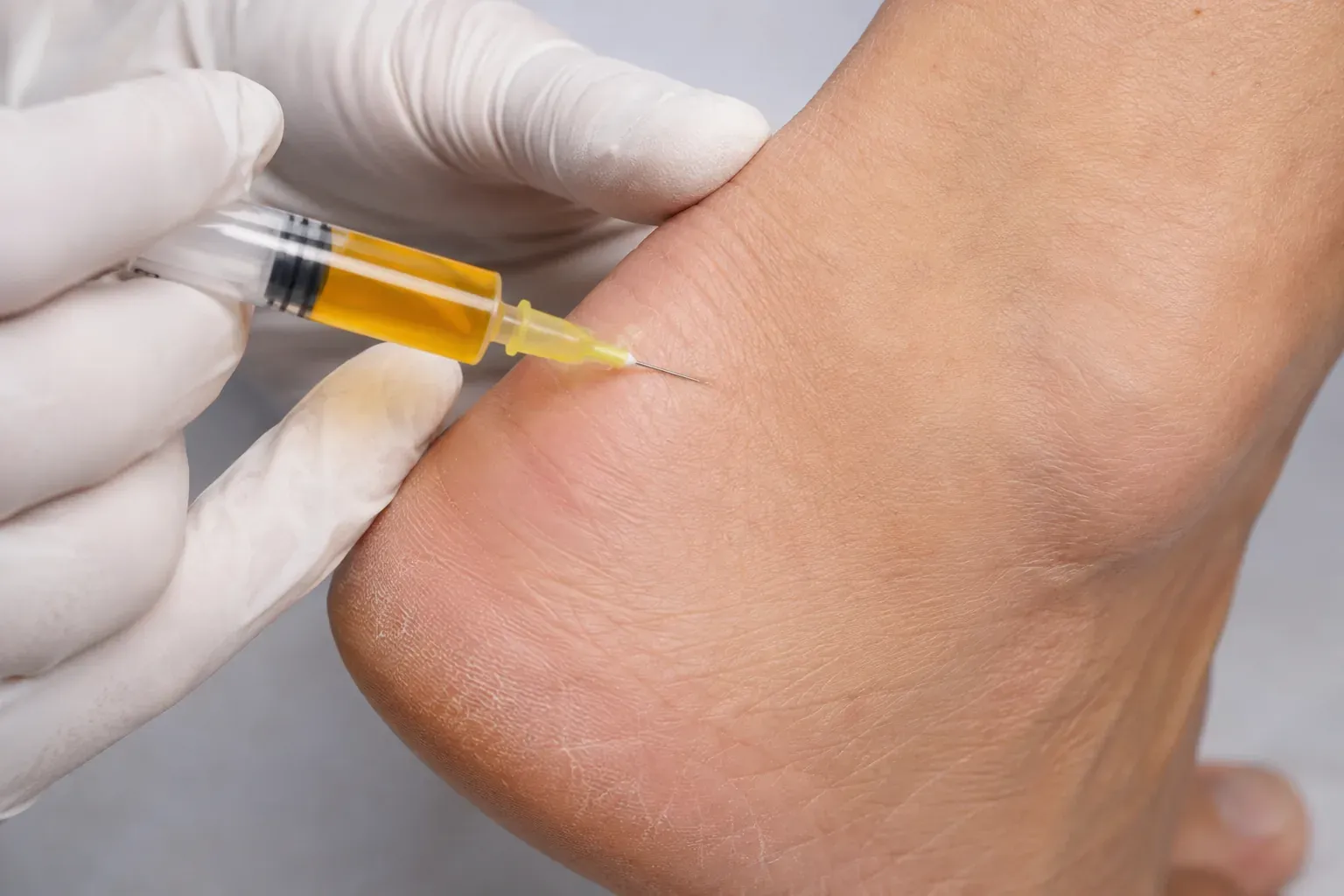
Corticosteroid is a powerful anti-inflammatory delivered directly into the inflamed compartment: a joint capsule, a bursa, or around (never inside) an irritated nerve. It shuts down the local inflammatory cascade at the source, with a small dose doing focused work that oral medication can't match. Placement is the craft; a few millimeters decides whether the medication bathes the target or misses it, which is why we guide difficult injections with ultrasound.
Best when inflammation itself is the problem or the roadblock: an arthritic joint too angry for rehab, a neuroma resisting padding, a gout attack that needs stopping today. Poor fit when tissue is degenerated rather than inflamed (chronic tendinosis), and firmly avoided in or near the Achilles tendon, where cortisone raises rupture risk. It's a targeted strike, not a wellness routine.
Exam (plus ultrasound when precision demands) confirms the pain generator, because cortisone in the wrong structure is worse than none.
Skin is numbed or coolant-sprayed; the injection itself takes seconds, with brief pressure more than pain. Ultrasound guidance for deep or small targets.
Sometimes a day of post-injection soreness, then relief typically arriving within 2 to 7 days. We schedule follow-up to judge response, which itself is diagnostic information.
You walk out and resume your day, with high-impact activity paused for a few days. Relief duration varies honestly: weeks to many months depending on the condition and what else we fix meanwhile. The injection buys a window; the mechanical plan (orthotics, footwear, rehab) is what makes the window permanent.
Real but manageable: a brief post-injection flare in some, small risks of skin lightening or fat-pad thinning at the site, blood sugar bumps for a few days in diabetics, and cartilage concerns with repeated joint injections, which is why we space them months apart and cap the count per joint per year. The strategic limit matters more: cortisone silences alarms without repairing anything, so it always travels with a plan that does.
Anywhere from weeks to over a year, and the spread isn't random: relief lasts longest when the underlying cause gets corrected during the quiet period. An injection plus mechanical fix often ends the problem; an injection alone usually schedules the next one.
General practice: no more than 3 to 4 in one area per year, spaced at least a few months apart, with diminishing justification each time. If a spot keeps needing cortisone, that's the tissue voting for a different plan, and we listen.
Because cortisone weakens loaded tendon tissue, and Achilles ruptures after injection are a well-documented catastrophe we decline to risk. For Achilles problems we use loading programs and shockwave, which fix rather than mask.
One suppresses your biology; the other concentrates it. Choosing correctly depends on which question your foot is asking.
Read the article →Laser is a real tool for fungal nails, wrapped in more hype than any treatment deserves. Here's the signal without the noise.
Read the article →Warts persist by hiding from your immune system. Swift's trick is blowing their cover.
Read the article →One exam at our Sugar Land office answers it. Call 346-594-9166 or book online.